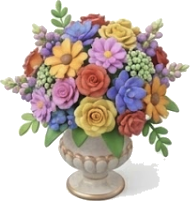
Most wedding centerpieces settle on one color family and stay there. This San Francisco arrangement does the opposite on purpose, running yellow, blue, orange and purple together in a single piece so a table gets a work of color rather than a quiet accent.
The four flowers doing the work
- Hydrangea for full, textured volume that holds the brighter blooms together
- Calla lilies for clean sculptural lines and structure
- Gerbera for bright, open faces
- Dahlias for deep, many layered color
- A vivid yellow, blue, orange and purple palette across the whole piece
Four strong colors, held together by structure
Putting four saturated colors in one arrangement usually ends in noise. What keeps this one coherent is the job each
Most wedding centerpieces settle on one color family and stay there. This San Francisco arrangement does the opposite on purpose, running yellow, blue, orange and purple together in a single piece so a table gets a work of color rather than a quiet accent.
The four flowers doing the work
- Hydrangea for full, textured volume that holds the brighter blooms together
- Calla lilies for clean sculptural lines and structure
- Gerbera for bright, open faces
- Dahlias for deep, many layered color
- A vivid yellow, blue, orange and purple palette across the whole piece
Four strong colors, held together by structure
Putting four saturated colors in one arrangement usually ends in noise. What keeps this one coherent is the job each flower is given. The hydrangea supplies a soft mass that the brighter blooms sit against, so nothing floats on its own. The calla lilies run clean lines through the middle, which gives the eye something to follow. The gerbera and dahlias then carry the saturation. Take the hydrangea out and the color scatters. Take the callas out and the piece loses its spine.
Texture as much as color
The palette gets the attention, but texture is what makes it work at close range. Hydrangea heads are dense and papery, calla lilies are smooth trumpets, gerbera are simple open discs, and dahlias are packed with layer after layer of petal. A guest seated at the table sees four different surfaces catching light in four different ways, which is why the piece rewards a close look rather than only reading from across the room. A single flower type at this color intensity would flatten out.
One table or the length of a room
The design is a single centerpiece, and it can be ordered in multiples so the same energy repeats down a long table or across a room of rounds. Repeating it is what turns one bright object into a scheme, and because each arrangement is made to the same recipe the room reads as deliberate rather than as a set of unrelated bunches. Hosts who want wedding flower centerpieces with real color tend to order several and let the palette carry the space.
Where it earns its place
Weddings, galas and private dinners are the settings it was built for, along with any celebration that has a color theme worth committing to. It suits a room that can carry a statement: a long dinner table, a gala round, a party where the flowers are meant to be discussed rather than ignored. It is not a background arrangement, which is the whole point of it, and it is a poor fit for an event that wants its flowers to disappear.
Flowers treated as part of the design
Most centerpieces are chosen last and asked to disappear. This one is for the host who treats flowers as part of the design of the event, on the same list as the linen and the lighting rather than beneath it. The deliberately artsy mix of color and form is what makes it a talking point instead of a default, and that is the reason to choose it: not because it matches everything, but because it is the thing guests mention. An event with real personality can carry that. A room that wants to stay neutral cannot.
Tuning the palette
The mix shown is a starting point rather than a fixed recipe. The four colors can be pulled toward an event theme, weighted in one direction, or dialed back if you want the same energy at lower volume. Because the blooms are fresh and seasonal, the exact flowers shift with what is at its peak, and any substitution is chosen to keep the same bold, contemporary character.
Made to order, delivered ready to set
Each centerpiece is made to order and arrives fully arranged, so there is nothing to assemble on site and it goes straight onto the table. The florist delivery service covers San Francisco and the nearby California area. Confirming the palette early gives the most certainty on which seasonal blooms make up the mix.
Studio terms
Full service wedding floral bookings carry a minimum spend; smaller a la carte pieces such as bouquets and boutonnieres can be arranged for pickup or delivery. One revision round is included, and the single mockup arrangement comes after the contract is signed, normally thirty to sixty days before the wedding. Delivery runs inside about fifty miles; please confirm venue access windows when planning. Same day delivery on everyday bouquets closes late morning, and wedding and event florals need booking well ahead. Substitutions are at the studio's discretion, with the client notified.

 Florists