Empowering Teams: How Virtual Events Propel Company Success and Growth
The best remote or virtual team building activity depends on your team's size, time zones, and what you're trying to accomplish. Small groups (under 15) work well with interactive activities like virtual cooking classes or escape rooms, where everyone can participate actively. Larger groups...
How to Choose the Right Activity
The best remote or virtual team building activity depends on your team's size, time zones, and what you're trying to accomplish. Small groups (under 15) work well with interactive activities like virtual cooking classes or escape rooms, where everyone can participate actively. Larger groups benefit from structured activities with breakout rooms.
Time zones are the biggest logistical challenge for remote teams. Look for activities that can run during overlapping work hours, and keep the duration under 90 minutes to avoid screen fatigue. Some vendors offer asynchronous options where team members can participate at different times, which works well for globally distributed teams.
Consider whether you want the activity to be purely social or tied to a professional development goal. Some virtual team building activities focus on communication and collaboration skills, while others are designed to be pure fun. Both have value, but knowing your goal helps narrow the options. Events in Minutes lists duration, group size, and format for each activity so you can find the right fit.
Top Picks

Building a Virtual Event Program That Works
Start with clarity on what you're trying to achieve. Are you trying to reduce turnover? Build specific skills? Cross-train departments? Create culture? The goal shapes which events you choose.
Next, survey your team about preferences. Some people love competitive games. Others hate them. Some want learning. Others want relaxation. Getting actual data beats guessing. Ask "which activities sound fun to you" and let people choose what excites them.
Start with one event, get feedback, refine based on actual response. Don't try to run the perfect program immediately. Build it iteratively based on what your actual team responds to.
Finally, involve people in planning. Have a team member help select activities, coordinate scheduling, send reminders. This distributes the work and increases buy-in from the people doing the selecting.
The Connection-Retention Relationship
Research across industries shows a clear pattern: employees with strong internal relationships are dramatically more likely to stay with their company. A person who has genuine friendships at work views the company differently than someone who just has professional acquaintances. The former thinks "how do I solve this problem with my team." The latter thinks "is this worth putting up with."
Remote work amplifies this effect. In physical offices, incidental connection happens naturally. People chat in hallways, grab lunch together, overhear conversations. In distributed settings, connection requires intention. You need to deliberately create moments when people interact outside of task-focused meetings.
Virtual events are that intentional connection. A 1-hour virtual escape game might cost $50-500 depending on team size. But if it prevents one person from leaving who would cost 6-12 months salary to replace, the ROI is enormous. Most companies don't calculate it this way, but they should.
The calculation is simple: retain one person per year through connection and you've paid for years of team events. Most teams retain 2-3 people annually through proactive culture and connection investment.
How Virtual Events Build Engagement and Productivity
Engagement in teams is a direct function of connection. People work harder for people they like. They speak up more in meetings. They contribute ideas they might otherwise keep quiet. They help colleagues solve problems without being asked. Disconnected teams go through motions.
Virtual team events increase engagement by breaking the transactional nature of remote work. A video call about Q3 targets is transactional. A 1-hour virtual trivia game where you're cheering teammates on is human. When you interact with people in non-work contexts, your brain creates different relationship maps. You see them as people, not just functions.
Virtual Rapid Fire Trivia ($40 per person, 10-1,000 participants, 1 hour) exemplifies this. Everyone's participating at the same time. Scores are visible. There's friendly competition. People are laughing, cheering, and fully present. That hour of engagement produces relationship shifts that show up in how people interact for weeks afterward.
Engaged teams also innovate more. They share ideas more freely. They challenge each other in constructive ways. They take more intelligent risks because they trust their colleagues to have their back. This translates directly to productivity gains and better problem-solving.
Virtual Team Events Scale to Any Size
One advantage of virtual events is scalability. You can run the same activity for 10 people or 500 people without major logistics changes. This makes it feasible to include entire departments, divisions, or companies in a single event. In-person events typically max out at 50-100 people before logistics become unwieldy.
Virtual Escape Game ($50 per person, 10-1,000 participants, 1 hour) scales from 10 to 1,000 without meaningful change to the experience. The same puzzle structure works whether it's one team of 10 or 100 teams of 10. The instructor can handle that range because it's all happening through video.
Virtual Murder Mystery ($60 per person, 15-500 participants, 1.5 hours) handles complex interactions at scale. Participants roleplay characters while solving a mystery. The instructor manages pacing and narrative. Scalability is built in.
For cooking and creative workshops, the per-person scalability changes slightly (smaller per-group caps), but it still works. The Self-Guided Virtual Escape Room ($30 per person, 5-1,000 participants, 1 hour) actually has no scaling limit. It's self-guided, so participants move through it at their own pace. A company with 10,000 people could run this simultaneously at various start times.
This scalability matters because it means you can include your entire organization in connection-building activities. You're not forced to choose which teams get to participate. Everyone can.
Virtual Cooking and Creativity at Scale
Creative activities work at scale through virtual delivery. Virtual Cheese & Charcuterie Board ($95 per person, 8-500 participants, 1 hour) has an instructor guiding everyone through assembling beautiful boards. Participants work at home, follow instruction, and create something consumable together. The shared meal happens across distributed locations but creates a moment of collective satisfaction.
Virtual Chocolate Candy Making ($85 per person, 8-500 participants, 1 hour) follows similar structure. Participants prepare ingredients in advance, instructor demonstrates technique, everyone creates candies, and there's a shared moment of tasting what people made.
Virtual Paint & Sip ($65 per person, 12-50 participants, 3 hours) creates a different feel. It's smaller, more intimate, and slower-paced. People relax over three hours while creating art. The experience feels like an actual break from work, not a compressed task.
Virtual Tote Bag Painting ($75 per person, 12-50 participants, 2.5 hours) and Wine Glass Painting ($75 per person, 12-50 participants, 2 hours) offer similar relaxed creativity. Virtual Hand-Painted Coaster Sets ($85 per person, 12-50 participants, 2 hours) has the advantage of creating coasters people will use constantly, extending the memory of the event.
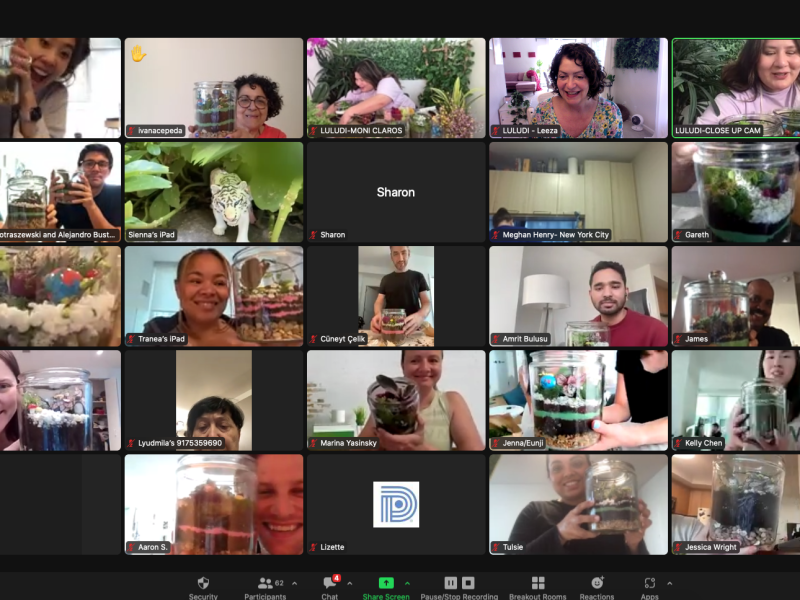
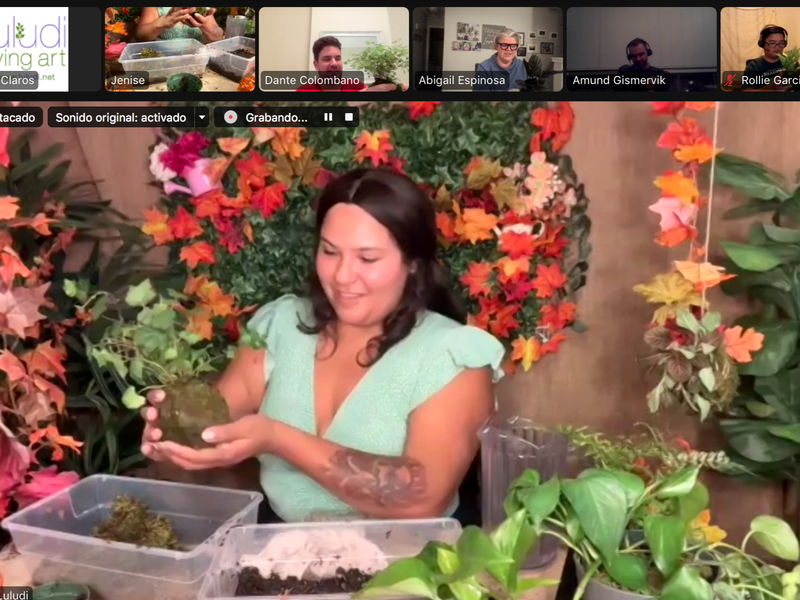
Plant-focused activities appeal to wellness-oriented teams. Virtual Mini Terrarium Workshop ($50 per person, 4-300 participants, 1 hour), Virtual Closed Terrarium Workshop ($90 per person, 8-500 participants, 1 hour), Virtual Moss Wall Workshop ($80 per person, 8-500 participants, 1 hour), Virtual Succulent Terrarium Workshop ($80 per person, 8-500 participants, 1 hour), and Virtual Seasonal Wreath Workshop ($85 per person, 8-500 participants, 1 hour) all scale well. Participants receive plant materials, instructor guides them through creation, everyone ends with living plants they care for after the event.
The Business Case for Virtual Team Events
Let's build a concrete ROI calculation. Assume a company with 100 employees where annual turnover is 15% (12-15 people leave per year). Average total cost to hire and train a replacement is 50% of annual salary. So losing one $100k employee costs about $50k in direct costs (recruiting, training, lost productivity). Indirect costs (knowledge loss, morale impact) add another $20-30k.
If virtual team events reduce annual turnover from 15% to 12% by improving retention (just 3 percentage points), you're saving roughly 3 people at $75k each = $225,000 annually. Running quarterly virtual events at $50-100 per person = $400-800 per person annually = $40,000-80,000 company-wide. The ROI is 2-5x.
This assumes modest improvement. Most companies see bigger shifts. Research suggests engaged teams have 20-30% lower turnover, not 3%. The calculation becomes far more favorable.
Add productivity improvements from increased engagement (studies suggest 10-15% productivity gains for engaged teams), and the business case becomes overwhelming. Virtual team events are among the highest-ROI investments a company can make in people.
Virtual Events and Company Culture
Culture isn't created by values statements on the wall. It's created by shared experiences. When teams do things together, especially outside the normal work context, culture forms. Virtual events are how distributed companies create that shared experience.
A company that runs quarterly virtual team events develops a different culture than one that doesn't. Employees know they work for an organization that invests in their connection. They experience their colleagues in different contexts. They accumulate shared memories and inside jokes. That's culture.
Culture matters for recruitment too. When job candidates interview, they notice if the company feels connected or fractured. Candidates want to work somewhere people like each other. A company with strong team culture becomes attractive to better candidates. Virtual events are visible proof that a company cares about culture.
Frequency: How Often Should You Run Virtual Events?
The research suggests monthly is ideal, but not all companies can sustain that. Quarterly is highly effective and sustainable. Annual is insufficient for building real connection.
A typical schedule might look like: Q1 - Escape Game or Trivia, Q2 - Cooking or Creative Activity, Q3 - Different Creative Activity, Q4 - Full-team event. This provides variety while maintaining regular rhythm.
Some companies do monthly smaller events (30-40 minute activities for self-selected groups) plus quarterly larger all-hands events. Others do quarterly all-company events. Both approaches work. The key is consistency. People learn to expect and plan around these activities. They become part of company rhythm.
Measuring Success Beyond Anecdotes
To justify spending on virtual events, measure outcomes. Track engagement scores on company surveys before and after implementing regular events. Survey participation rates (percentage of eligible employees attending). Measure internal retention rates over time. Compare team productivity metrics before and after introducing events. Collect satisfaction ratings after each event.
Most companies implementing quarterly virtual events see: 5-15% increase in engagement survey scores within 6 months, 60-75% attendance rates (excellent for optional activities), measurable retention improvements within 12 months, and 80%+ satisfaction ratings on the events themselves.
These metrics matter for securing continued budget. When leadership sees that team events correlate with retention and engagement, they become a permanent budget item rather than something that gets cut during tight quarters.
Overcoming Objections to Virtual Team Events
Some leaders worry that virtual events feel forced or that people prefer to opt out. This is real initially but changes with execution. If your first events are generic and awkwardly run, people will resist. If your events are genuinely fun and well-executed, participation rises over time.
The key is starting with activities known to work (escape games, trivia) where the structure does most of the heavy lifting, then expanding to activities matching your team culture as you learn what resonates.
Some worry about cost. Budget $50-150 per person per quarterly event. For a 100-person company doing four events, that's $20,000-60,000 annually. Compare to turnover costs and it's trivial. Frame it with leadership that way.
Comparison of Virtual Event Options by Growth Goals
| Goal | Best Event Types | Frequency | Budget/Person/Year |
|---|---|---|---|
| Build Connection | Escape games, trivia, creative | Quarterly | $200-400 |
| Improve Engagement | Competitive activities, cooking | Quarterly | $240-500 |
| Boost Retention | Varied activities, team choice | Monthly-quarterly | $300-600 |
| Strengthen Culture | All-company events, repetition | Quarterly | $250-500 |
| Cross-functional collaboration | Mixed-team activities | Monthly-quarterly | $300-700 |